

Australia’s Most Comprehensive Range of Lehmann Glassware 🥂🍷🍸 Shop Today


To discover how your glass of champagne relates to women, let’s go back to the roots—historically, to the forward-thinking women who shaped champagne as we know it today; and literally, to the terroir from which grapes are carefully developed and transformed by a new generation of forward-thinking, boundary-pushing women.
As any lover of wine will surely know, not all sparkling wines of the world are created equal. Even those that use méthode champenoise, the traditional method of winemaking that governs all champagne production in Champagne, won’t taste like champagne. Nor is champagne rivalled in terms of celebrity, fame and fortune. But why?
The answer is, of course, terroir.
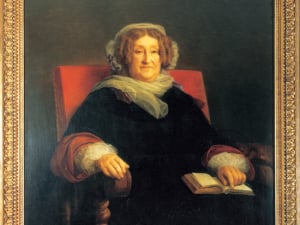
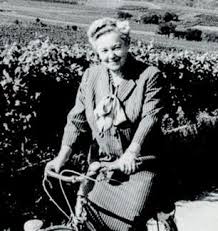
We can see this when we step back in time to the turn of the 19th and 20th centuries and consider the oenological contributions of a group of brilliant women who wielded their wit, ingenuity and tenacity to forge the Champagne landscape that we know and love today. We are, of course, referencing Madame Clicquot, Madame Pommery and Madame Bollinger, whose extraordinary stories are covered in a previous Le Journal article.
Thrust into their respective family businesses after their husbands passed away unexpectedly, each of the three champagne widows threw themselves into developing their brand and expanding the business.
With an innovative mindset and fierce commitment to quality, each of them set out to craft clearer, more sophisticated and stylised champagnes through methods that ultimately led to finer expressions of terroir and became integral to shaping Champagne’s identity. The wines of Champagne, which still carry this legacy now even after two centuries, have undoubtedly set the benchmark against which all sparkling wines around the world are judged.

One of these is not like the others
But what exactly is terroir?
It’s a mysterious French term that cannot be easily translated, but it is a term that conceptualises ‘a sense of place’. It encompasses the myriad unique and interactive factors in a region—such as climate, soil, terrain, elevation, topography and viticultural practices—that shape a grape’s development and subsequent flavour profile and thereby differentiate them from the same grapes grown in other regions, and even neighbouring vineyards.

Only 1.8ha in size, one of the world’s most prized vineyards, Romanée-Conti, is a Grand Cru climat of the Vosne-Romanée commune in Burgundy. Image credit: Romanee-conti.fr
Consider Burgundy, for example. It is the undisputed Mecca of Pinot noir and Chardonnay, where a small corridor of mostly contiguous winegrowing districts represents a complex patchwork of carefully delineated, often miniscule, parcels of vines or specific vineyard sites (known as climats), each with its own unique history, identity and propensity for creating wines of distinct character—sometimes commanding exorbitant prices—owing to small nuances in microclimates and geological conditions. Here, it is clear that terroir is a technical, physical and cultural construct that underpins the modern winemaking world’s philosophy that ‘great wine is made in the vineyard’.

Looking towards the village of Chouilly
It is the centrality of terroir and the dedication to crafting terroir-focused wines that make the French, and especially the Champenois, such a dominant force in the wine world. Furthermore, it is the accumulation of centuries of know-how and a profound respect for the delicate viticultural ecosystem that drives the region’s leading figureheads and winemakers to continue creating wines of exceptional natural heritage. In focusing on terroir, the resulting wines are wines unique to a certain time and place—even if all other factors are equal, the same wine can’t be made in any other place or in any other time.
Just as the techniques and approaches to winemaking developed by the widowed Champenoises of the 19th and 20th centuries emphasised terroir, so too are the next generation of women refining the practices and techniques, though with a focus on environmental sensitivity and innovation in the face of a changing climate. In the heavily male-dominated industry of Champagne today, where just 14% of grape growers are women, it becomes even more essential to acknowledge and celebrate the relatively significant proportion of women who are championing great wines of terroir like their revolutionary predecessors.

Anne Malassagne – Champagne A.R. Lenoble Image credit: winemag.com
Anne Malassagne, one of the pioneers of La Transmission (an all-female initiative of nine influential decision-makers in Champagne, which we spotlight in a previous Le Journal article) and co-owner of Champagne A. R. Lenoble, spoke to Wine Enthusiast Magazine about her 30-year mission of independently crafting unique champagnes that transmit terroir: ‘our credo is the life of the soil. That way, you have fewer grapes and better quality’.
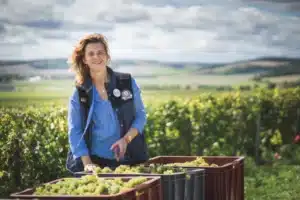
Hélène Beaugrand Image credit: sipchampagnes.com
Hélène Beaugrand, the passionate winemaker behind the recently launched, eponymous label, and who is part of Les Fa’Bulleuses de Champagne (read more here), the seven-strong association of young female vigneronnes leading small, independent grower-producer Champagne Houses, recounted her decision to take her family’s Estate in a new and terroir-focused direction: ‘I’m doing things a little bit differently. I have created six cuvées and they are all low dosage—between 0 and 5 g/L—and also one special cuvée called Derrière la Cabane which comes from one specific plot and is more distinctive of the terroir of Montgueux than past wines. My first harvest is 2018—good champagne takes time!’.
Good champagne certainly does take time, and perhaps no-one knows this better than Sophie Larmandier, who has spearheaded the innovative grower-producer House of Champagne Larmandier-Bernier in the Côte des Blancs with her husband Pierre, since 1988, leading a quiet movement towards sustainable farming.

Sophie and husband Pierre – Champagne Larmandier-Bernier
In the early 1990s, Pierre and Sophie abandoned the use of herbicides and took to organic viticulture in a quest to make great wines in respect of the environment and a healthier way of life. By 1999, and long before current awareness, Pierre and Sophie were fastidiously applying biodynamic farming techniques across their entire Estate—a practice that still continues today, along with natural vinification and minimal intervention methods, with the support of their two sons. In 2003, the trailblazing Estate received organic certification. The family’s burning conviction? To create ‘wines which express their terroir, without any tricks’.
In an exclusive interview with iDealwine, Sophie elaborated on the family’s impetus to change viticultural methods at a time when organic cultivation was virtually non-existent (in 2009, just 0.5% of Champagne’s vineyards were certified organic): ‘All in all, the ‘90s allowed us to piece together all of the different elements surrounding viticulture. I must say that this philosophy demands time and investment, but it is rewarding and makes the profession so much more enjoyable’.
It is thanks to the early pioneers of sustainable viticulture in Champagne, such as Sophie and Pierre, that the region became, in 2003, the world’s first wine growing region to assess its carbon footprint, as a consequence of climate change. Since then, the Comité Interprofessionnel du Vin de Champagne (CIVC), the region’s trade association and governing body, has conducted an environmental audit of all its processes every five years to monitor the pace of emission reductions. The CIVC aims to secure environmental certification for 100% of its vineyards by 2030—and it is with a great sense of achievement and collective pride that the newest generation of rising stars in the grower-producer sphere—such as Domaine Vincey (headed by Quentin Vincey and Marine Zabarino, a young couple in the Côte des Blancs) and Domaine de Bichery (led by another young couple, Raphaël and Hannah Piconnet, in the Côte des Bar)—count their vineyards among the 63% already certified.
Elise Bougy is another young female winemaker with a passion for crafting conscientious artisanal champagne. After a few years of formal education in agricultural management and international trade in wine and spirits, and another six years of experience in Paris, Elise combined her love of wine (a legacy passed down from her late mother Maryse) and keen interest in entrepreneurship to launch her own agency, Les Bouchons d’Elise, in Champagne in 2014, offering consultancy services and selling wine and spirits. A burning desire to uphold ‘the good and the beautiful, the passion for the wines of artists and emotions while respecting environmental values’ meant that she soon took on her next big venture as vigneronne of the family Estate in 2016. She began applying organic and biodynamic farming principles in 2018, and all vineyards at are 100% alive. Without disturbances, with no intervention on the juices … I let it go’.
Elise’s positive, impactful energy can be felt in her equally remarkable wines, for which she has gained worldwide attention and commendable accolades. In 2021, Elise was a winner of the Prix des Artisans in the Food & Wine category, an award organised by ELLE and the LVMH Group to recognise the exceptional savoir-faire of talented females artisans in craft métiers. In 2022, Elise was crowned Winegrower of the Year in the prestigious Les Trophées Champenois Awards. Her cuvées are also featured on the wine lists of Michelin-starred restaurants in Champagne (L’Assiette Champenoise and Domaine les Crayères, just to name a few)- an incredible achievement given that her first release was from the 2018 vintage.
This International Women’s day, we toast to the pioneering women of Champagne, past and present, who are every day deserving of full recognition – not just for their tireless efforts in improving the quality of champagne, and promoting and protecting environmental rights, but for also creating supportive networks for female talent in Champagne, through which there are already significant and quantifiable outcomes.
In 2017, a report published by the Harvard Business Review focused on a sample of sales made by grape growers in Champagne over a 17-year period. It found that female growers were able to negotiate consistently higher prices for grapes of the same quality from their male counterparts. Through qualitative research, it was discovered that this discrepancy in price was due to ‘the relationships developed and maintained by the women growers’. Being a minority group, female growers sought social support from each other through networking and developing informal relationships, which frequently led to the sharing of business acumen and market information that male growers would typically keep to themselves.
Without a doubt, women benefit from collaboration over competition in Champagne and beyond. It is our belief that female leadership and entrepreneurship will only rise in Champagne, as women continue to empower and actively support one another. In fact, just last week, Elise Losfelt succeeded Cyril Brun as chef de cave of Champagne Charles Heidsieck, breaking up a long line of male cellar masters at the Maison. As the saying goes: ‘A rising tide lifts all boats’.
The rising tide of female winemakers will certainly lift Champagne.
To find out more about the Champagne Houses we have mentioned in this article, and to explore a range of pioneering grower champagnes made by women, please visit the links below:

